Make HubSpot work across your marketing, sales and website stack
Codalent helps B2B marketing and sales teams design, migrate, configure and connect HubSpot around the way they actually capture, qualify and manage demand. Get a governable CRM foundation, reliable automation and the technical support to launch without leaving your website, data or integrations behind.
No fixed rollout promise before we understand your portal, data, systems and decision process.
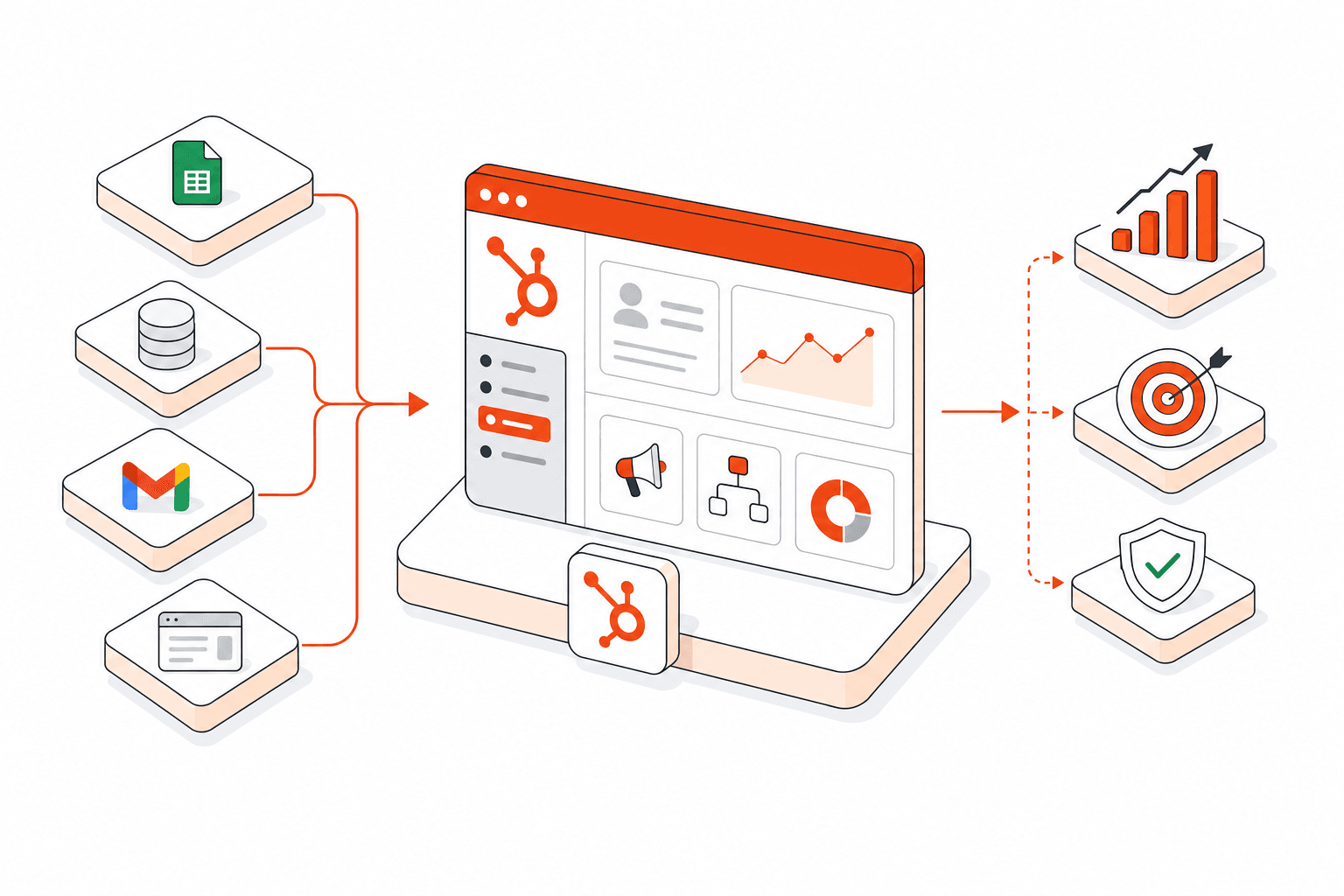
Built for marketing teams with real technical dependencies
A HubSpot setup your team can operate
Scope is shaped around your portal, process maturity, connected systems and delivery priorities.
CRM architecture
Define objects, properties, associations, lifecycle stages, pipelines and ownership rules. Your team gets a clearer operating model for segmentation, handoffs and reporting.
Data migration and cleanup
Audit source data, map fields, set deduplication rules and plan migration runs. This reduces avoidable duplicate records and protects useful account and opportunity context.
Automation and routing
Configure forms, lists, workflows, notifications and lead-routing rules with documented test cases. Marketing and sales can act on agreed processes rather than manual workarounds.
Website and conversion setup
Implement forms, consent behaviour, campaign parameters, redirects and tracking validation. Lead capture is connected to the website experience and measurable campaign activity.
Reporting and handoff
Set up relevant dashboards, documentation and role-based enablement. Your team can understand key definitions and make routine operational changes after launch.
Ongoing technical capacity
Keep a technical backlog for integrations, CMS work, data quality and improvements. You have access to delivery support when requirements evolve.
Technical decisions that keep HubSpot maintainable
We select the simplest approach that meets the required data model, reliability and operating needs. Available HubSpot capabilities depend on your subscription and portal configuration, so these are confirmed during discovery.
Source-of-truth design
For each entity and field, we define which system may create and update it. This avoids treating bidirectional sync as a default and helps prevent conflicting updates.
Native sync or custom integration
We assess HubSpot data sync and native connectors first. Where they cannot support required relationships, timing or business rules, we can use APIs, middleware or webhooks.
Reliable API and webhook handling
Custom connections consider scopes, secure HTTPS endpoints, signature validation, rate limits, retries, idempotency and logging. These controls make failures easier to detect and resolve.
Workflow governance
Workflows are treated as production systems: enrollment, re-enrollment, suppression, delays, exception paths and ownership are documented and tested before release.
Website, consent and measurement
HubSpot forms and CMS work are aligned with cookie consent, GTM, GA4, campaign parameters and conversion events. This protects lead capture and gives reporting a more consistent foundation.
Replace fragmented HubSpot delivery with clear technical ownership
Portal configuration often stalls when website, CRM, data and integration work sit with different people and no one owns the full flow.
An integrated extension of your marketing and sales team
Use Codalent as an integrated extension of your team: more coordinated than managing freelancers and more flexible than building every capability in-house.
Subscribe and assemble the team
Bring in the developers, technical project manager and marketing-technology expertise your HubSpot priorities require. You get focused capability without coordinating separate suppliers.
Prioritise in ClickUp
Manage implementation tasks, dependencies and acceptance criteria in a shared ClickUp board. The backlog stays visible as requirements, access and business priorities change.
Collaborate in Slack and weekly calls
Use a dedicated Slack channel and weekly cadence calls to resolve decisions, review progress and keep marketing, sales and technical stakeholders aligned.
Deliver, review and improve
Release work in controlled increments, validate it and document it. Codalent AI can assist research, planning, documentation and quality checks, while people retain technical ownership and review.
Plan a HubSpot implementation your team can run
Tell us what you are implementing, migrating or repairing. We will help identify the architecture, technical dependencies and delivery support required.
HubSpot implementation FAQs
What is included in HubSpot implementation services?
Typical work includes discovery, CRM architecture, data audit and mapping, portal configuration, forms, workflows, reporting, website tracking, integrations, testing and documentation. The final scope depends on your hubs, subscription, source systems, data quality and internal ownership.
Do we need a HubSpot implementation partner if our team can configure HubSpot?
Your team may handle straightforward setup internally. Technical support is most useful when the work involves migration, complicated data ownership, custom integrations, website or CMS changes, tracking validation, workflow remediation or a need for ongoing engineering capacity.
Can you migrate us from Salesforce, Pipedrive, Marketo or a legacy CRM?
Yes, subject to an audit of the source data, exports and relationships. We map records and fields, define deduplication and transformation rules, test representative data, reconcile results and plan cutover. The aim is to preserve useful operational context, not replicate uncontrolled legacy complexity.
How do you prevent duplicates and preserve associations during migration?
We establish stable identifiers, field mappings and association rules before importing. Contacts, companies, deals and other records are reviewed as connected data rather than isolated spreadsheets. Pilot imports, record samples and reconciled counts help identify issues before a production cutover.
When is a native HubSpot integration enough?
We assess native connectors and HubSpot data sync first when they support the required records, field mapping, direction and update behaviour. A custom API, middleware or webhook approach is considered when native options cannot meet your data relationships, timing, reliability or application requirements.
Can you work with our existing website and technology stack?
Yes. Codalent can implement HubSpot forms, tracking and conversion paths on an existing site, and can support frontend, CMS or backend work where needed. During discovery, we review access, release processes, consent requirements and the systems that exchange data with HubSpot.
How are tasks prioritised and how does communication work?
Work is prioritised in a shared ClickUp board based on dependencies, risk and business value. A dedicated Slack channel supports day-to-day collaboration, while weekly cadence calls provide a regular point to review delivery, resolve decisions and adjust the backlog.
Can you maintain or improve an existing HubSpot portal?
Yes. We can audit unreliable forms, workflows, integrations, tracking and property governance, then prioritise remediation. This is useful when a portal has accumulated technical debt but does not require a complete rebuild.
Who owns the completed work, and what happens when requirements change?
Completed configuration, documentation and implementation work are handed over to your team. Changes are managed through the shared backlog, with impacts on data, automation, integrations and testing reviewed before work is prioritised.
Plan a HubSpot implementation your team can run
Tell us what you are implementing, migrating or repairing. We will help identify the architecture, technical dependencies and delivery support required.
No fixed rollout promise before we understand your portal, data, systems and decision process.