AI agents built around your real workflows
Codalent designs, integrates and supports governed AI agents for marketing, support and operations teams. Automate bounded workflows across your existing systems while keeping people in control of sensitive actions.
We start with one valuable workflow, connect the systems it depends on and build the controls needed to operate it — not an open-ended, general-purpose agent.
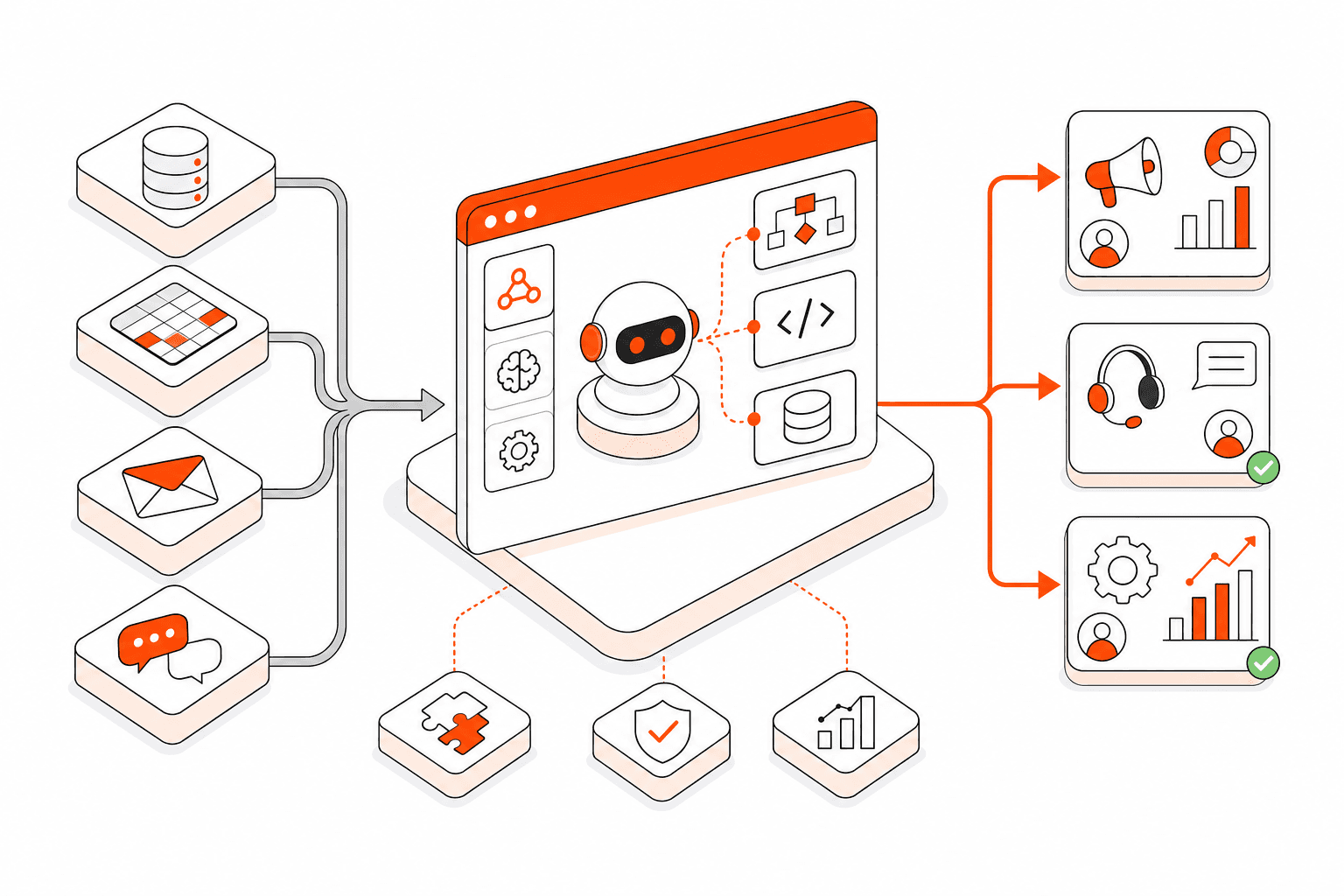
Teams supported by Codalent
A production-ready agent, not another disconnected chatbot
We start with one valuable workflow, connect it to the right systems and establish clear operating controls.
Workflow discovery
We map users, triggers, business rules, systems, handoffs and failure points. You receive a practical scope with measurable acceptance criteria.
Purpose-built agent
We build structured instructions, decision logic, tool actions and exception paths for the selected use case. Your team gets consistent assistance for a defined process.
Business-system integrations
The agent can connect with relevant CRM, CMS, analytics, knowledge and communication systems. This reduces repetitive copying and disconnected handoffs.
Approval and escalation flows
Sensitive actions can pause for a person to approve, edit, reject or escalate. Your team retains control over customer-facing or consequential changes.
Evaluation and operations
We define representative tests and track completion, quality, latency, failures and operating cost. You can review performance and prioritise improvements with evidence.
Deployment and handover
Documentation, environment setup, monitoring, runbooks and ongoing support prepare the agent for day-to-day use rather than a one-off demonstration.
Technical choices shaped by the workflow and its risk
Codalent selects models, orchestration, integrations and infrastructure according to the task, data sensitivity, required actions and operating environment — not a fixed framework.
Models and orchestration
Model APIs such as the OpenAI Responses API and orchestration approaches such as LangGraph may support tool use, durable workflows or human review. Selection depends on capability, cost, latency and maintainability.
Structured tools and APIs
REST APIs, validated schemas and deterministic rules handle classifications, routing and record updates where possible. This makes actions easier to test and reduces unnecessary model judgement.
Knowledge and retrieval
Approved documents and current system records can provide grounded context with source metadata and access rules. Retrieval is used only where it improves the workflow; it does not replace data governance.
Identity and guardrails
Role-based access, least-privilege credentials, tool allowlists, validation and approval gates limit what the agent can do. Data retention, secrets, PII and log redaction are addressed before production access.
Reliability and observability
Tracing, audit logs, timeouts, limited retries, checkpoints and graceful handoffs make failures reviewable. Monitoring quality, latency and cost supports reliable operation and informed iteration.
Move from an isolated AI prototype to an owned workflow
Common blockers include fragmented systems, unclear permissions, weak production controls and limited technical capacity. Teams move context between tools by hand, generic copilots ignore company-specific rules, and prototypes stall without testing, monitoring or clear ownership.
An integrated technical team for ongoing agent delivery
The subscription provides flexible access to developers, a technical project manager and marketing-technology expertise. It is more coordinated than multiple freelancers and more flexible than building a full internal team.
Subscribe and assemble the team
We align the mix of developers, technical project management and marketing-technology support with your workflow. You gain accountable technical ownership without staffing every capability internally.
Prioritise work in ClickUp
Requirements, tasks, decisions and progress stay visible in a shared ClickUp board. Ongoing prioritisation keeps delivery focused as business needs or technical findings change.
Collaborate in Slack and weekly calls
A dedicated Slack channel and weekly cadence calls support direct communication, reviews and decisions. Codalent AI assists research, planning and documentation while people retain ownership and approval.
Deliver, review and improve
We release tested increments, review workflow evidence and plan the next priority. The same team can support integrations, knowledge updates, monitoring and agent improvements after launch.
Planning a new AI agent, integration or improvement?
Tell us about the process, systems, permissions and success measures involved. We will help you identify a bounded starting point and the technical work needed to operate it — starting from an existing prototype or a clearly defined operational problem.
Custom AI agent development FAQs
How is a custom AI agent different from a chatbot or standard automation?
A chatbot mainly exchanges messages, while standard automation follows predefined rules. A custom agent can interpret less structured input, use approved tools and complete a bounded multi-step workflow. Codalent combines model judgement with deterministic rules, permissions and human review where the action requires more control.
Which workflows are suitable for an AI agent?
Good starting points have clear inputs, repeatable decisions, accessible source data and measurable outcomes. Examples include campaign and content operations, lead research and routing, support triage, analytics investigation, knowledge assistance and controlled CRM or CMS updates. We avoid starting with a broad, general-purpose agent.
Can the agent work with our current technology stack?
Codalent can assess integrations with systems such as HubSpot, CMS platforms, GA4, Slack, ClickUp, internal knowledge repositories and proprietary APIs where access is available. We review authentication, API quality, permissions, rate limits and data readiness before confirming the appropriate integration design.
How do you prevent an agent from making risky changes?
We define permitted tools and actions, use scoped credentials, validate structured inputs and separate read-only work from write access. Publishing, sending, deleting or changing sensitive records can require approval. Logs and escalation paths make activity reviewable, although no technical control should be presented as eliminating every possible error.
How do you select the model and agent framework?
Selection follows the workflow requirements rather than a preferred vendor. We consider task quality, tool support, latency, operating cost, data policies, hosting constraints and maintainability. We can also work within technology choices set by your internal engineering or security team when they meet the implementation requirements.
How are quality, cost and business value measured?
We agree a baseline and representative test set before launch. Relevant measures may include workflow completion, output quality, safe tool use, handling time, rework, escalation rate, latency and model cost. Production feedback then informs prioritised changes instead of relying on isolated demonstrations.
What is included in the Codalent subscription?
The subscription can include developers, a technical project manager, marketing-technology expertise, a dedicated Slack channel, a shared ClickUp board, weekly cadence calls and Codalent AI support for research and delivery. The exact team shape and priorities depend on the agreed engagement and required capabilities.
Can Codalent maintain or improve an existing AI agent?
Yes, subject to an initial technical review. We assess the architecture, prompts, workflows, integrations, permissions, tests, monitoring and documentation. The subscription is designed for ongoing delivery and improvement, but a bounded initial project can also be discussed when the requirement has a clear handover point.
How quickly can the team start, and who owns the work?
Start timing depends on team availability, scope, system access and security requirements, so it is confirmed during the commercial process. Ownership and handover terms are documented in the engagement agreement. Requirements can be reprioritised through ClickUp and cadence calls as new information emerges.
Choose a practical first workflow for your AI agent
Discuss the process, systems, permissions and success measures with Codalent. We will help you identify a bounded starting point and the technical work needed to operate it.
No fixed architecture or commitment is required before the first conversation.