A WordPress site your marketing team can control
Codalent builds, improves and migrates WordPress websites for SMBs, publishers and marketing teams. Get reusable editing tools, reliable integrations and an accountable technical team without adding internal development overhead.
No fixed launch promise is made before the requirements, dependencies and content readiness are assessed.
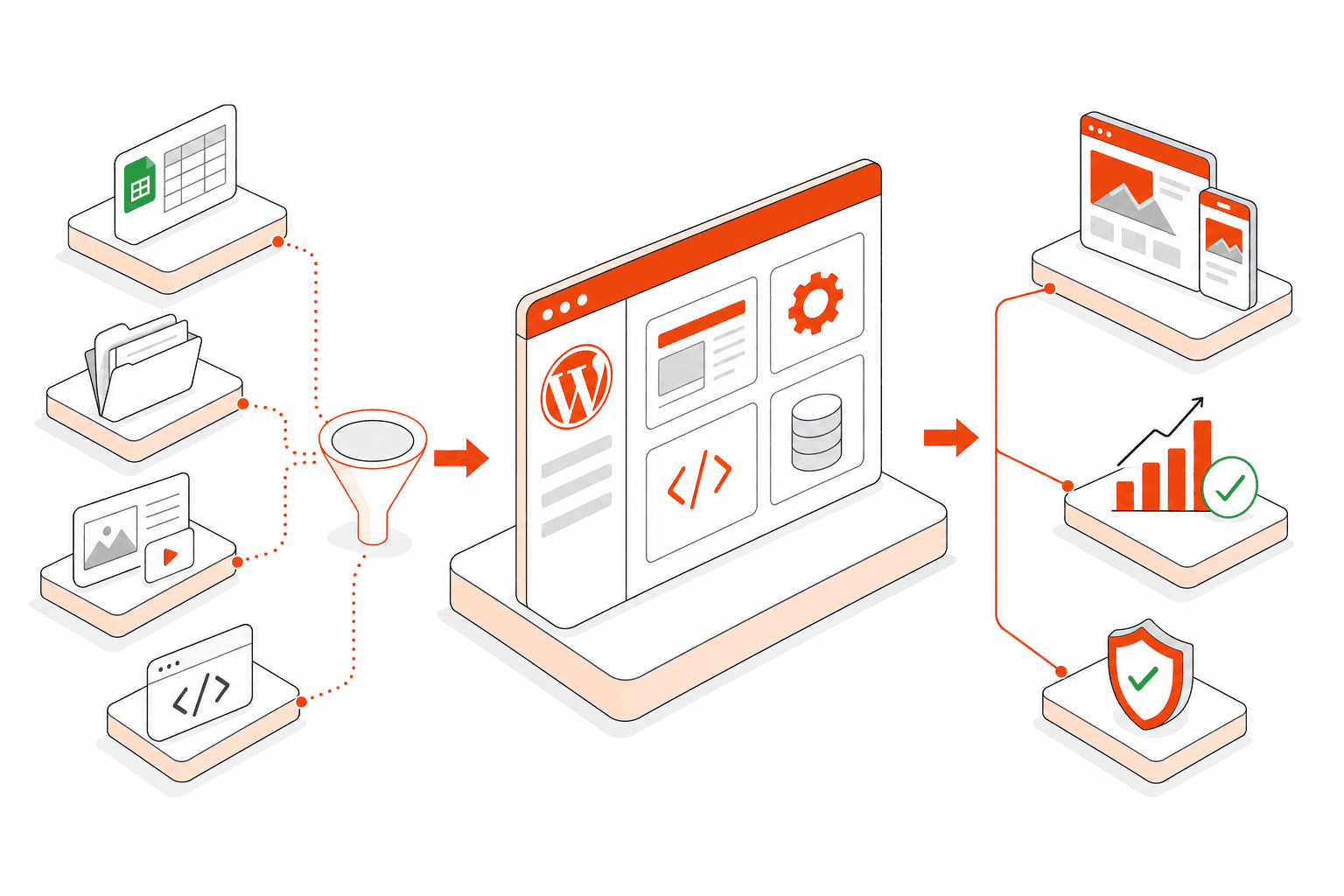
Teams supported by Codalent
WordPress development built around publishing and growth
We shape the implementation around how your team creates content, launches campaigns and operates the website.
New builds and redesigns
Receive an implementation plan, maintainable WordPress build and structured launch process. Your team gets a site designed for real publishing requirements rather than static mockups.
Editor-friendly page systems
Give approved editors reusable templates, patterns and controlled components. Marketing can assemble consistent pages without requesting development for every routine change.
CMS migrations
Codalent handles content mapping, migration, redirects and launch validation. This reduces avoidable disruption to publishing, search visibility, forms and analytics.
Custom functionality
Add business-specific content types, workflows, forms and features where standard options fall short. You receive functionality aligned with your operations rather than unnecessary plugins.
Marketing-system connections
Connect WordPress with CRM, analytics, automation, search, ecommerce or internal systems. Marketing data moves through defined, testable workflows with clearer ownership.
Ongoing improvement
Maintain a prioritised backlog for enhancements, updates, QA and performance work. Your website continues improving after launch instead of accumulating unmanaged technical debt.
Choose the simplest WordPress architecture that meets the requirement
Codalent assesses editorial workflows, integrations, content volume, hosting and maintenance responsibilities before recommending an approach.
Blocks, patterns and theme controls
Core Gutenberg blocks, patterns and theme.json controls can create a governed editing system. Custom blocks are reserved for repeatable business-specific modules, keeping publishing flexible without exposing unnecessary design choices.
Content architecture
Post types, taxonomies, fields, permissions and archive rules are defined around publishing operations. Early content modelling makes pages easier to manage, reuse, migrate and expand.
Traditional, hybrid or headless
A conventional WordPress front end is often the simplest option. Headless or hybrid architecture can support multiple channels or application experiences, but adds preview, routing, caching, SEO and operational complexity.
Plugins and API integrations
Plugins are evaluated for maintenance, compatibility, licensing, performance and data ownership. Bespoke plugins or the WordPress REST API may be used when standard options cannot safely support the required workflow.
Performance and reliable releases
Work can include asset and image optimisation, caching coordination, Core Web Vitals measurement, accessibility-aware QA and analytics testing. Version control, staging, backups and rollback planning make changes safer to operate.
Security and maintainability
Custom code uses appropriate permissions, validation, sanitisation and output escaping. Dependencies, update ownership and environment access are documented so maintenance remains controlled after release.
Replace WordPress bottlenecks with accountable delivery
Marketing teams often inherit slow releases, fragile dependencies, unclear ownership and disconnected suppliers. Campaign pages wait for scarce engineering time, plugin and theme dependencies make routine changes risky, and maintenance stays reactive rather than prioritised.
An integrated WordPress team without building one internally
The subscription can combine developers, a technical project manager and marketing-technology expertise around your active priorities.
Subscribe and assemble the team
Codalent assigns the technical capabilities required for your WordPress roadmap. You gain flexible access to specialists with clear human ownership.
Prioritise work in ClickUp
Requirements, dependencies and tasks are organised in a shared ClickUp board. Codalent AI can support research, planning and documentation while the team reviews decisions.
Collaborate through Slack and calls
Use a dedicated Slack channel and weekly cadence calls to resolve questions, review priorities and coordinate stakeholders without fragmented handovers.
Deliver, review and improve
The team develops, tests, releases and reviews completed work through a transparent cadence. Priorities can evolve as campaign, publishing and operational needs change.
Planning a new WordPress build, migration or improvement?
Tell us whether you are starting fresh, moving from another CMS or improving an existing WordPress site. We will discuss your workflow, current stack and immediate priorities.
Questions before choosing a WordPress agency
What is included in WordPress development services?
Scope can include audits, architecture, custom themes, block systems, content modelling, migrations, integrations, performance work, technical SEO, QA, deployment and ongoing maintenance. The specific backlog is agreed around your website, publishing workflow and commercial priorities.
Can Codalent improve our existing WordPress site without rebuilding it?
Yes. Codalent can audit the current theme, plugins, content structure, integrations, performance and release process. Remediation may be more practical when the foundation is viable; a rebuild is considered when structural limitations make incremental work disproportionately risky or costly.
Can our marketers create landing pages without developers?
That is often a core objective. Reusable blocks, patterns, templates and controlled design settings can let editors assemble approved layouts independently. Developer involvement remains available for new components, integrations and changes that require technical review.
How do you protect SEO and tracking during a migration?
Migration planning can cover URL inventories, redirect mapping, metadata, canonicals, internal links, sitemaps, crawlability, forms, analytics events and post-launch checks. These controls reduce avoidable risk, but rankings or traffic outcomes cannot be guaranteed.
How do you select the right WordPress technologies?
The team assesses editorial needs, existing systems, hosting, integrations, security, performance and maintenance ownership. Core WordPress capabilities are preferred where suitable; plugins, custom code or headless architecture are selected only when their benefits justify the added operational complexity.
What is included in the Codalent subscription?
An engagement may include developers, a technical project manager, marketing-technology expertise, a dedicated Slack channel, shared ClickUp planning, weekly cadence calls and Codalent AI support. The team composition follows the agreed backlog and required capabilities.
How are changing tasks and priorities handled?
Work is maintained in the shared ClickUp board and reviewed through ongoing communication and weekly calls. New requirements can be assessed against current commitments, dependencies and risk so stakeholders can make informed priority decisions.
How do you handle testing, security and deployment?
The approach can include development and staging environments, version control, code review, responsive and accessibility-aware QA, analytics testing, backups, launch checklists and rollback planning. Exact controls depend on the host, architecture and access available.
Make your next WordPress release easier to manage
Bring Codalent a new build, migration, integration, performance issue or ongoing backlog. We will help clarify the technical options and practical next steps.
No fixed launch promise is made before the requirements, dependencies and content readiness are assessed.