Turn internal knowledge into grounded, useful answers
Codalent designs and builds retrieval-augmented generation systems for companies with scattered documents and knowledge repositories. Give marketing, product, support and operations teams a permission-aware assistant with current sources, citations and measurable retrieval quality.
We start with one bounded use case that can deliver value without connecting every repository at once — not an open-ended, general-purpose knowledge bot.
Trusted by teams that need dependable technical delivery
A complete knowledge experience — not just a chatbot
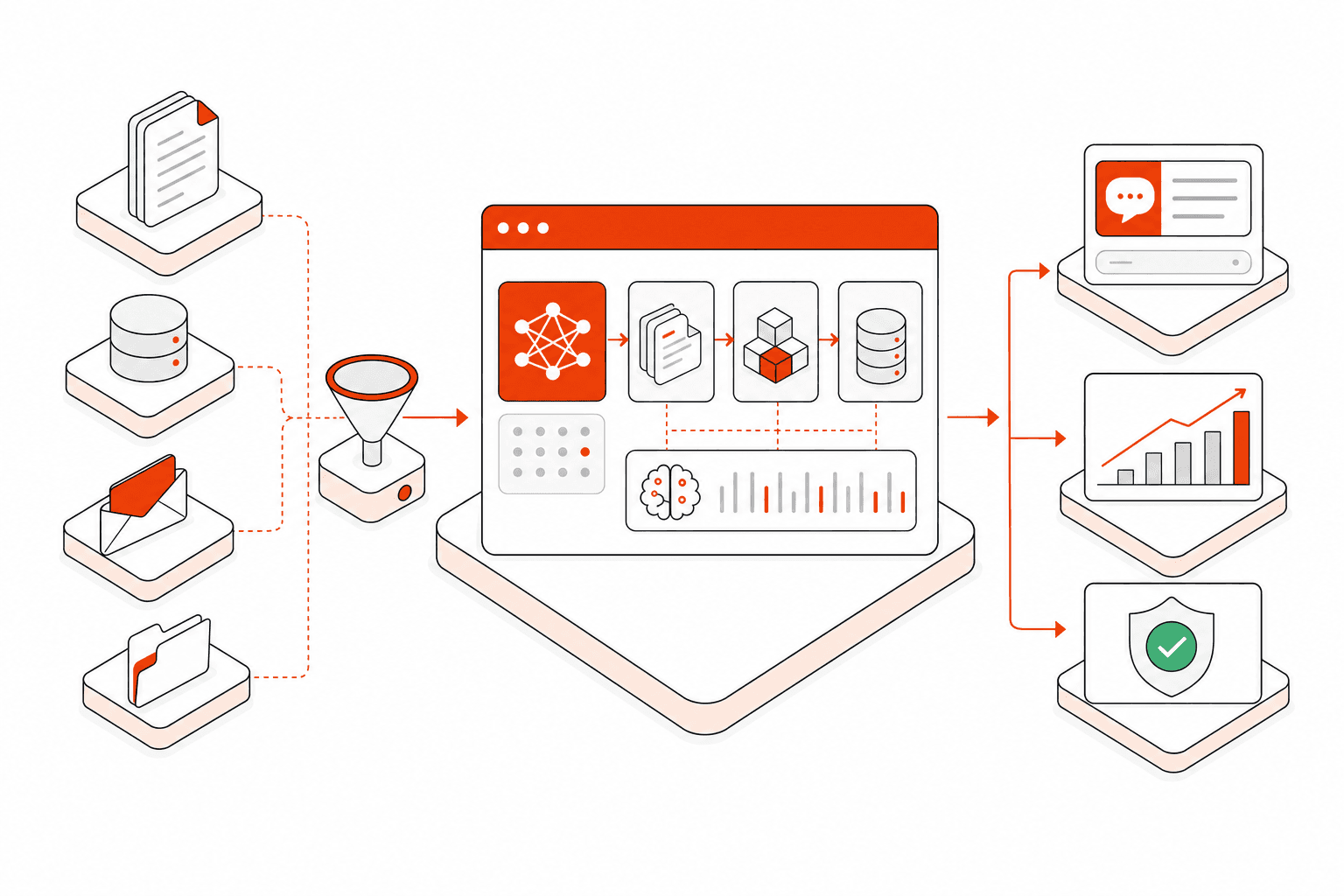
Codalent handles the retrieval, integration and operating workflows required to move from a limited prototype to a maintainable system.
Use-case and source discovery
We define users, questions, repositories, access rules and success criteria. You start with a bounded use case that can deliver value without connecting everything at once.
Content ingestion
We prepare selected files, web content, APIs and databases through parsing, normalization, metadata and refresh workflows. Your assistant can use better-structured, current source material.
Permission-aware retrieval
Authentication and retrieval-time access controls are designed around your identity and source systems. Users receive results appropriate to their role rather than relying on prompts for protection.
Cited answer experience
We build the backend and interface for web, product, Slack, Teams or internal portals. Answers can include citations, deep links and an insufficient-evidence response.
Quality evaluation
Representative questions, retrieval checks, citation reviews and regression tests expose weak results before and after release. Your team gets evidence and an improvement backlog.
Monitoring and handover
Query tracing, error logging, feedback capture and update documentation support ongoing ownership. The system remains observable as content, prompts and user needs change.
RAG architecture selected around your content, users and risk
We assess source complexity, permissions, expected questions, latency, cost and integration requirements before recommending a managed platform or custom retrieval stack.
Managed or custom retrieval
Managed knowledge bases can accelerate standard document use cases. Custom pipelines offer more control over connectors, ranking, tenancy, data handling and branded experiences.
Semantic and hybrid search
Embeddings and vector search support meaning-based discovery. Keyword matching, metadata filters and reranking can improve results when exact terminology, versions or product names matter.
Content preparation and freshness
Chunking is tested by document type and user question. Scheduled or event-driven synchronization handles additions, updates and deletions so obsolete content can be retired.
Grounding and access controls
The response policy uses retrieved evidence, citations and abstention behavior. Authorization is enforced in the retrieval path, with prompt injection, untrusted content and audit requirements considered.
Evaluation and observability
We assess retrieval relevance, groundedness, citation correctness, latency and cost by source and user role. Monitoring and regression tests make later changes safer and easier to maintain.
Move beyond scattered documents and an unowned prototype
RAG projects often stall because source ownership is unclear, permissions are added late, quality is judged informally and internal engineering has competing priorities.
An accountable technical team integrated with yours
Your subscription can combine developers, a technical project manager and marketing-technology expertise. It provides more coordination than multiple freelancers, more flexibility than building a full internal team and ongoing ownership beyond a traditional outsourced project.
Subscribe and assemble the team
We align the required specialists with your RAG scope and existing stack. You gain flexible access to the capabilities needed without assembling separate suppliers.
Prioritise work in ClickUp
Requirements, technical tasks and improvements are managed in a shared ClickUp board. Codalent AI can assist research, planning and documentation, with human review and ownership.
Collaborate through Slack and weekly calls
A dedicated Slack channel and weekly cadence calls keep decisions, blockers and priorities visible. Your stakeholders communicate directly with the delivery team.
Deliver, review and improve
We release work, review evaluation evidence and reprioritise the backlog. Transparent delivery supports ongoing ingestion, integrations, quality improvements and maintenance.
Planning a new RAG system, integration or improvement?
Tell us which users, repositories and workflows matter. We will discuss the likely scope, technical constraints and a practical starting point without assuming your content is production-ready.
RAG development questions
What are RAG development services?
RAG development connects a language model to selected company knowledge at query time. The work includes source ingestion, retrieval, access controls, answer policies, citations, application integration, evaluation and monitoring — not only a model or vector database.
Which internal sources can a RAG system use?
Potential sources include SharePoint, Google Drive, Confluence, Notion, CMS platforms, helpdesks, databases, APIs and file repositories. We validate formats, connector behavior, metadata, permissions and update requirements before confirming the appropriate scope.
Will RAG prevent unsupported or incorrect answers?
No system can guarantee correct answers. We reduce risk through evidence-based prompting, citations, insufficient-evidence behavior, representative evaluation questions and regression testing. Authoritative source systems remain the final reference.
How do you select the right RAG architecture?
We consider the use case, corpus size, document formats, permissions, expected queries, integrations, latency, cost and operational requirements. A focused two-step flow may suit predictable Q&A, while hybrid or more dynamic retrieval is justified only when its added complexity provides value.
Can Codalent improve an existing RAG prototype?
Yes. We can review an existing implementation, including ingestion, chunking, search configuration, prompts, citations, permissions, latency and monitoring. Findings are converted into a prioritised improvement plan rather than assuming a full rebuild.
What is included in the subscription?
The subscription can include developers, a technical project manager, marketing-technology expertise, a dedicated Slack channel, shared ClickUp board and weekly cadence calls. The team composition and priorities depend on the agreed requirements.
How are requirements and changing priorities handled?
Work is prioritised through the shared ClickUp board and reviewed through Slack and weekly calls. When requirements change, we assess the effect on architecture, scope and dependencies, then make the updated priority and trade-offs visible.
Who owns and maintains the completed work?
Ownership and handover arrangements are agreed as part of the engagement. Codalent can provide technical documentation, update workflows and ongoing maintenance, or collaborate with your internal team and chosen platforms to support a controlled transition.
Build a RAG system your team can verify and improve
Tell us which users, repositories and workflows matter. We will discuss the likely scope, technical constraints and a practical starting point without assuming your content is production-ready.
No fixed architecture or commitment is required before the first conversation.