Move your Claude integration from prototype to production
Codalent helps product, marketing and operations teams embed Claude into real products and workflows — with secure API architecture, system integrations, structured outputs, testing and operational controls.
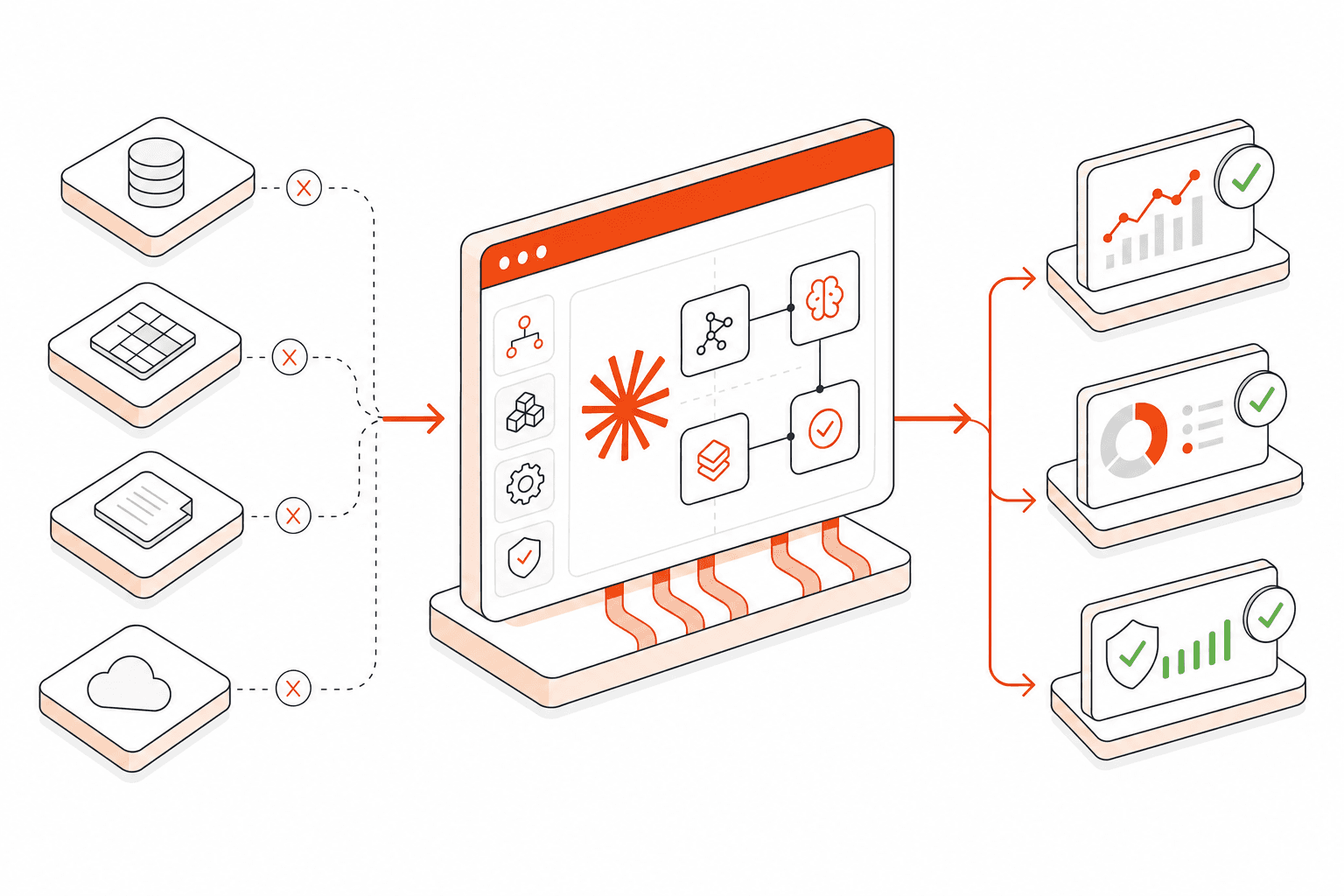
We start with one defined use case, connect the systems it depends on and build the controls needed to operate it — not an open-ended AI experiment.
Teams supported by Codalent
A Claude integration built around an actual workflow
Start with one defined use case, connect the systems it depends on and establish the controls needed to operate it.
Workflow and solution design
We map users, data, systems, success measures and approval requirements, giving your team a practical scope instead of an open-ended AI experiment.
Claude API development
We build the authenticated backend connection, error handling and application logic required to add Claude to an existing product or internal workflow.
Business-system integrations
Claude can be connected to approved CMS, CRM, HubSpot, helpdesk, analytics, database or internal API workflows so results reach the systems where teams work.
Knowledge and document workflows
We prepare approved content and design permissions-aware retrieval for assistants, document analysis and operational tools, helping users work from relevant business context.
Review interfaces and controls
We create embedded assistants, review queues or operations consoles with confirmation and escalation steps where publishing, messaging or record changes require human judgment.
Evaluation and ongoing support
Representative tests, release criteria, documentation and an improvement backlog give your team visibility into quality and a controlled path for future changes.
Architecture selected for your systems, risk and operating model
We assess data sensitivity, procurement, Claude-specific features, traffic, latency and ownership before choosing an integration route. The goal is a maintainable application layer — not logic tied to one prompt or dated model identifier.
Direct API or cloud route
The native Claude API supports Claude-specific capabilities such as Structured Outputs and prompt caching. Amazon Bedrock may better fit existing AWS identity, billing or procurement requirements; the choice depends on the project.
Secure backend integration
Credentials remain server-side behind authenticated services that enforce user permissions, data minimisation and rate limits. This protects keys and keeps browser-facing experiences governed.
Structured outputs and tools
JSON schemas, validation and strict tool definitions make results usable by downstream systems. Allowlisted actions, idempotency, audit logs and confirmation steps reduce the risk of unsafe writes.
Context and knowledge access
Retrieval preserves source permissions and identifies authoritative content. Prompt caching and context trimming can improve repeated workloads, while external documents and connectors are treated as untrusted input.
Reliability and observability
Evaluations, regression tests, queues, timeouts, backoff, token budgets and usage monitoring support controlled releases. Centralised model configuration makes future model changes easier to test and maintain.
Close the gaps between AI, engineering and operations
Claude projects often stall when the prototype has no system integration, production owner or release process. Free-form responses cannot safely drive automation, permissions and prompt injection stay unresolved, and internal engineering lacks capacity for production ownership.
An integrated team for delivery, support and improvement
Access the technical capabilities your roadmap requires without coordinating multiple freelancers or building a full internal team.
Subscribe and assemble the team
Your subscription can include developers, a technical project manager and a marketing-technology expert. You get flexible access to relevant skills with accountable technical ownership.
Prioritise work in ClickUp
Requirements, risks and tasks are managed in a shared ClickUp board. Codalent AI can support research, planning and documentation while people retain review and decision-making responsibility.
Collaborate every week
Use a dedicated Slack channel and weekly cadence calls to resolve questions, review priorities and coordinate with internal stakeholders. This reduces handovers and keeps project visibility clear.
Deliver, review and improve
We build, test, deploy and monitor agreed increments, then use feedback and evaluation results to reprioritise. Your Claude integration can improve as workflows and platform capabilities change.
Planning a new Claude build, integration or improvement?
Tell us what you want to connect, automate or add to your product. We will discuss the workflow, systems, controls and technical ownership required — starting from an existing prototype or a clearly defined operational problem.
Anthropic Claude integration FAQs
What is included in Anthropic Claude integration services?
Scope can include workflow discovery, architecture, backend API development, prompt and retrieval design, structured outputs, tool integrations, user interfaces, evaluations, deployment, monitoring and documentation. We agree the combination around one defined use case, its systems and its risk level.
Can Claude connect to our CMS, CRM, HubSpot or internal APIs?
Yes, where suitable APIs and permissions are available. We map each system of record, define what Claude may read or propose, and restrict consequential writes. Integrations can support content operations, lead or support triage, knowledge access, document processing and internal tools.
Should we use the direct Claude API or Amazon Bedrock?
The answer depends on required Claude features, AWS architecture, identity controls, procurement, networking, billing and data requirements. We assess those constraints before recommending a route. Native API access may be preferable when the workflow relies on specific Claude platform capabilities.
Can Claude return predictable data for automation?
Claude supports structured outputs that can conform to defined JSON schemas. We combine schemas with application-level validation, error handling and acceptance tests before data updates another system. Human approval remains appropriate when an output could publish content, contact customers or change important records.
How do you handle security, prompt injection and sensitive actions?
Keys stay server-side, users are authenticated and tools receive least-privilege access. We treat uploaded files, websites, emails and connectors as untrusted input. Sensitive actions can require allowlisting, validation and explicit approval. Retention requirements are checked against the selected route, features and contract.
How do you control Claude API costs and reliability?
Depending on the workflow, controls can include task-based model selection, token budgets, context trimming, prompt caching, queues, timeouts, retries that respect rate limits, spend alerts and usage dashboards. We test realistic workloads and define fallback behaviour before customer-facing or operational release.
What does the subscription include, and how is work prioritised?
A subscription may include developers, a technical project manager, marketing-technology expertise, Slack, ClickUp and weekly calls. Work is prioritised collaboratively in the shared board as requirements change. Team composition and capacity are agreed for the engagement rather than assumed from a fixed package.
Can Codalent maintain an existing Claude prototype?
Yes. We can review the current code, prompts, data flow, permissions, integrations, tests and monitoring, then propose a prioritised improvement plan. Existing technology chosen by your internal team can remain where it is suitable; replacement is recommended only when the constraints justify it.
Turn one valuable Claude use case into an owned implementation
Tell us what you want to connect, automate or add to your product. We will discuss the workflow, systems, controls and technical ownership required.
Start with an existing prototype or a clearly defined operational problem — no prepared technical specification is required for the first conversation.