Connect AI agents to your business systems—with controlled access
Codalent designs and builds governed MCP servers for marketing, product and engineering teams. Give AI agents approved access to CRM, CMS, analytics and internal workflows without exposing broad APIs or relying on demo-grade connectors.
We start with a focused set of read and write workflows, connect the systems they depend on and build the permissions and approvals needed to operate them — not an uncontrolled tool catalogue.
Teams supported by Codalent
A production-ready MCP integration—not just a connector demo
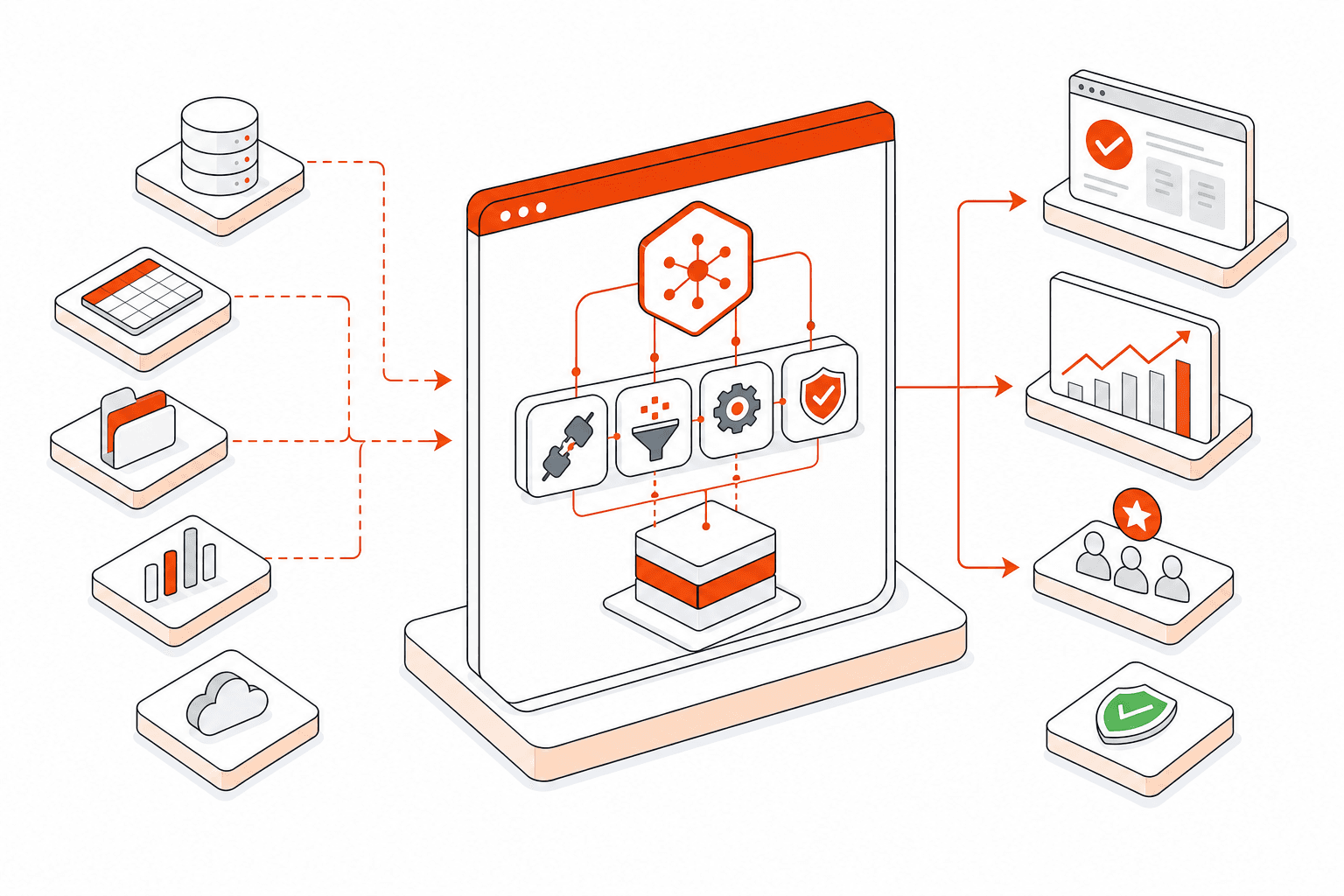
Codalent handles the integration layer from use-case discovery through deployment and ongoing support.
Use-case and access planning
We prioritise useful read and write workflows, identify system owners and define success criteria. Your team starts with a focused scope instead of an uncontrolled tool catalogue.
Custom MCP server development
We build a focused MCP server around your approved systems and workflows. This creates reusable, task-specific capabilities for compatible AI clients.
System adapters
We connect selected APIs, databases, CRM, CMS, analytics, DAM or internal services. Teams can retrieve current context without repeatedly navigating separate platforms.
Permissions and approvals
We define identity, scopes, access boundaries and approval points for sensitive actions. AI access remains limited to the users, data and operations you authorise.
Deployment and operational support
You receive tested deployment configuration, monitoring, audit events, runbooks and documentation. Optional maintenance covers protocol, SDK and connected-platform changes.
Technical decisions built around your workflows and risk profile
We select the server structure, transport, identity model and operational controls after reviewing the target AI host, connected systems, user groups and required actions.
Tools, resources and prompts
Tools support constrained retrieval or actions, resources provide contextual data, and prompts support reusable interactions. We expose a small, task-oriented surface to improve usability and reduce unnecessary access.
Local or remote transport
Local integrations may use stdio, while multi-user remote services commonly use Streamable HTTP and JSON-RPC. Selection depends on hosting, client compatibility, authentication and operational scale.
Identity-aware access
Where appropriate, OAuth or OIDC, token validation, narrow scopes, tenant context and managed secrets replace broad shared credentials. Server-side policy remains authoritative for consequential actions.
AI-safe system contracts
Adapters constrain inputs, shape outputs and handle pagination, timeouts, retries and rate limits. Read and write operations are separated, with approvals and idempotency added where needed.
Testing and observability
Contract, authorization and negative tests support reliable releases. Structured logs, correlation IDs, alerts and version testing help teams diagnose failures without unnecessarily recording sensitive payloads.
Move beyond fragmented, hard-to-govern AI integrations
Common blockers include one-off API connections, unclear ownership, broad service credentials and prototypes without monitoring or maintenance. Codalent brings the workflow, integration and operational work into one accountable delivery team.
An integrated technical team for ongoing MCP delivery
Access the developers, technical project management and marketing-technology expertise required without coordinating multiple freelancers or building a full internal team.
Subscribe and assemble the team
We assemble the appropriate developers, technical project manager and marketing-technology expert. You gain flexible access to the capabilities required for the current integration scope.
Prioritise work in ClickUp
Discovery, server development, adapters, testing and maintenance are prioritised in a shared ClickUp board. Everyone can see ownership, status and next steps.
Collaborate through Slack and weekly calls
A dedicated Slack channel and weekly cadence calls keep decisions moving. Codalent AI supports research, planning, documentation and quality assurance under human technical review.
Deliver, review and improve
We release reviewed work, monitor the implementation and reprioritise as workflows or platforms change. This supports accountable delivery and continuous improvement after launch.
Planning an MCP integration for your AI client and systems?
Tell us which AI client, marketing tools, product systems or internal workflows you want to connect. We will discuss the workflow, systems, controls and technical ownership required — starting from a clearly defined operational problem.
Model Context Protocol integration FAQs
What are Model Context Protocol integration services?
They cover the assessment, design, development, deployment and maintenance of MCP servers that let compatible AI applications use approved data and actions. Codalent also handles system adapters, identity, permissions, approvals, testing, monitoring and operational documentation.
Why not connect an AI agent directly to our existing APIs?
Existing APIs may expose more data or functionality than an agent needs. An MCP layer can provide narrower, AI-safe contracts with constrained parameters, shaped outputs, explicit permissions and approval policies while reusing your existing APIs behind the server.
Can we begin with a read-only MCP integration?
Yes. A limited read-only pilot is often a practical starting point for reporting, content discovery or workflow status. Write actions can be introduced later after identity, approval rules, testing and operational ownership have been validated.
How do you control what an AI agent can see and do?
Controls are designed per server, tool, user, tenant, environment and data class. Depending on the project, we use scoped authorization, input validation, output filtering, allowlists, action limits, server-side approvals, audit events and isolated execution.
Will the integration work with our preferred AI client?
Compatibility must be checked early. AI hosts can differ in supported MCP versions, transports, authentication flows, approval features and tool behaviour. We validate the target client and document the supported configuration rather than assuming identical interoperability.
Can Codalent work with our existing systems and technical choices?
Yes, subject to API access, permissions and platform constraints. We review your current CRM, CMS, analytics, databases and internal services, then select an approach that fits the target host, security model, maintenance capacity and workflow.
What is included in the Codalent subscription?
The subscription can include developers, a technical project manager, marketing-technology expertise, a dedicated Slack channel, shared ClickUp board, weekly cadence calls and Codalent AI support. The exact team and priorities depend on the agreed engagement scope.
How do you handle security, testing and deployment?
We define trust boundaries and access requirements before implementation. Delivery can include automated contract and authorization testing, environment separation, CI/CD, managed secrets, structured logging, alerts, runbooks and controlled pilots using limited-scope data.
Who owns the work, and can the subscription adapt?
Ownership and handover terms are agreed as part of the engagement rather than assumed. The shared backlog can be reprioritised when requirements change, and the team composition can be reviewed as work moves between discovery, development and maintenance.
Plan a governed MCP integration for your systems
Tell us which AI client, marketing tools, product systems or internal workflows you want to connect. We will help define a practical starting scope and the technical controls it requires.
Share what you know today. A complete technical specification is not required for the first conversation.