Keep releases and infrastructure under control
Codalent provides ongoing DevOps support for marketing and product teams without dedicated infrastructure staff. We help manage deployments, hosting, monitoring and operational risk so campaigns and product releases have a clearer path to production.
No obligation to replace your current stack or move accounts away from client ownership.
Teams supported by Codalent
Ongoing DevOps ownership, not another setup-and-leave project
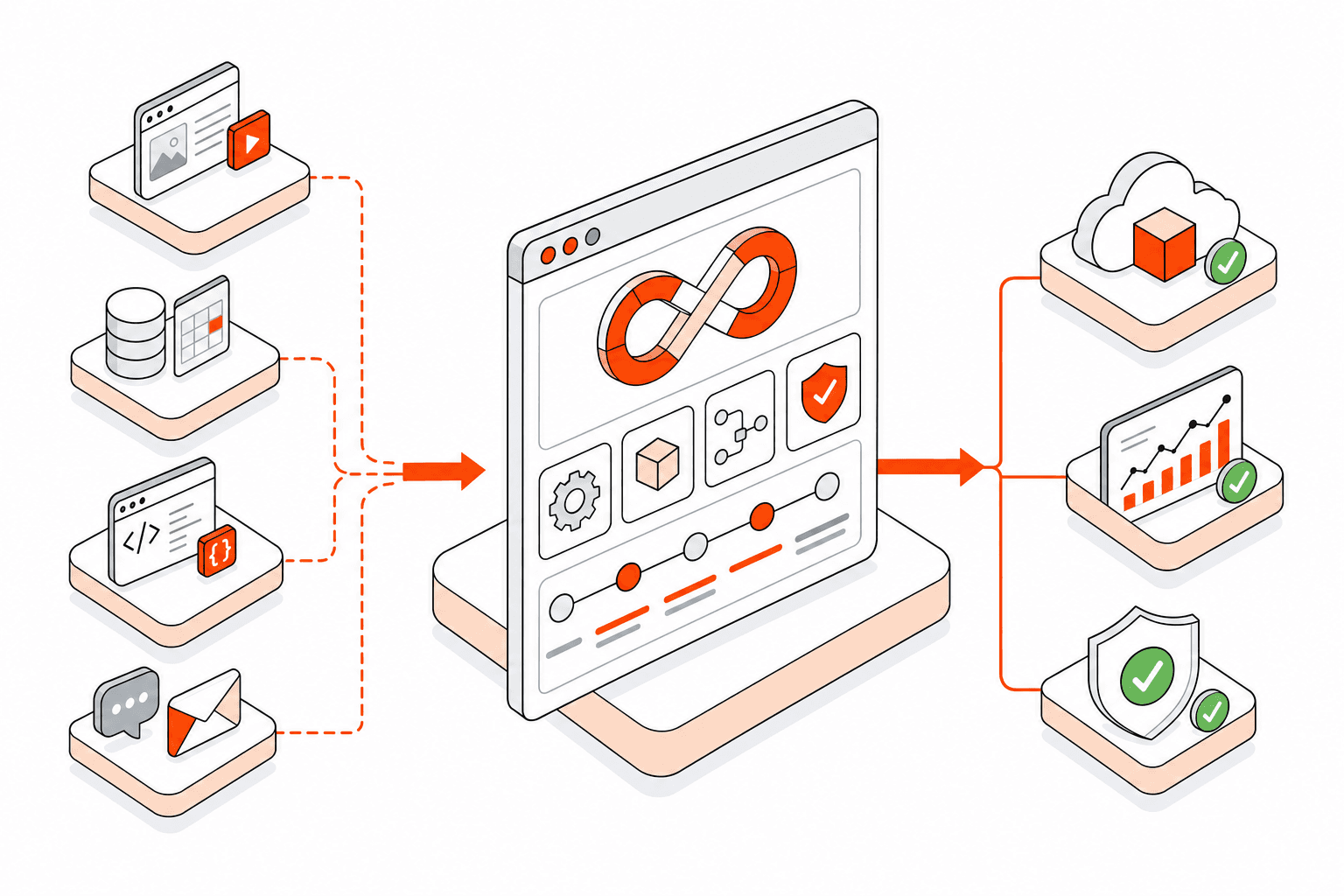
Codalent establishes the operating foundations, then maintains a visible backlog of improvements, risks and support work.
Operational discovery
We review applications, environments, dependencies, deployment paths, access and monitoring. You receive a prioritised risk register instead of relying on undocumented assumptions.
Defined support plan
Supported systems, service hours, approvals, escalation contacts and exclusions are documented. Your team knows who handles each operational issue and when.
Release management
We improve the path from approved code to production, including release checks, records and rollback procedures. Launches become easier to coordinate and review.
Monitoring and incident readiness
Monitoring, alert ownership, severity levels and practical runbooks are established around important user journeys. Problems can be assessed and communicated more consistently.
Operational improvement
We maintain a backlog covering reliability, performance, access, capacity and cost observations. Work is prioritised against business needs rather than handled only when something breaks.
A technical approach matched to your actual stack
We assess workload, release frequency, team capability and risk before selecting tools. A marketing site on Vercel or managed hosting needs a different operating model from an application running containers on AWS, Google Cloud or DigitalOcean.
Proportionate CI/CD
Pipelines can combine automated tests, protected environments, approvals, health checks and rollback steps. Controls are selected around release risk so routine changes remain efficient without leaving production unprotected.
Controlled infrastructure
Infrastructure as code, including Terraform where appropriate, can make changes reviewable and repeatable. Shared state requires secure remote storage, locking, access control and careful import or drift management.
User-impact monitoring
Infrastructure metrics are combined with checks for pages, forms, checkout, APIs or login flows. Alerts must be actionable and owned, helping teams focus on failures that affect customers or marketing activity.
Access and recovery controls
We review deployment permissions, secrets, backups and restore procedures. Approaches such as least-privilege roles and short-lived cloud credentials can reduce exposure while preserving auditable access.
We do not prescribe Kubernetes, Terraform or a cloud migration by default. Managed services, Docker, a CDN or a straightforward pipeline may provide a more maintainable result. Decisions account for performance, security, recovery needs, cost, portability and the operational capacity your team intends to retain.
Replace fragile DevOps handoffs with clear operational ownership
Managed DevOps is useful when delivery depends on manual knowledge, developers are pulled into infrastructure work or nobody owns production readiness.
An embedded team for ongoing DevOps delivery
The subscription provides more coordination than managing separate freelancers, with flexible access to the technical capabilities required as priorities change.
Subscribe and assemble the team
Codalent assigns developers, a technical project manager and marketing-technology expertise as required. You gain an integrated team without building every capability internally.
Prioritise work in ClickUp
Discovery findings, support requests and improvement work are maintained in a shared ClickUp board. Ongoing prioritisation keeps effort aligned with launches, risks and business needs.
Collaborate through Slack and weekly calls
A dedicated Slack channel supports direct communication, while weekly cadence calls cover progress, decisions and blockers. Your team retains clear project visibility.
Deliver, review and improve
We complete agreed work, document changes and review the next priorities. Codalent AI can assist research, planning, documentation and quality checks, with human technical ownership throughout.
Not sure how much managed DevOps support you need?
Start with what you run today, how releases work and where operational ownership is unclear. Codalent can begin with an assessment, a remediation backlog or ongoing support for selected systems.
Managed DevOps services FAQs
What is included in a managed DevOps subscription?
The agreed scope can cover operational discovery, deployment pipelines, environments, infrastructure changes, monitoring, access hygiene, backups, incident preparation and an ongoing improvement backlog. Supported systems, service hours, escalation paths, approvals and exclusions are defined in the proposal.
How is this different from a one-time DevOps project?
A one-time project may configure a pipeline or cloud environment and then hand it over. Managed DevOps adds ongoing operational ownership: maintaining the delivery process, reviewing risks, supporting releases, updating documentation and prioritising improvements as the application and marketing roadmap change.
Can Codalent work with our existing infrastructure?
Yes. We start by assessing the current runtime, hosting, repositories, deployment process, accounts and dependencies. Undocumented environments may require a discovery and stabilisation phase before automation. We recommend incremental changes where they are safer than rebuilding the stack.
Will you require Kubernetes, Terraform or a new cloud provider?
No. Technology choices follow the workload, risk profile and your team's ability to maintain the result. Managed hosting or a simple pipeline may be preferable for many marketing systems. Infrastructure as code or container orchestration is introduced only when its benefits justify the added complexity.
How do you handle production access and ownership?
We prefer client-owned cloud accounts, repositories, domains and credentials. Access can use named, least-privilege roles, approval gates and auditable deployment permissions. Ownership boundaries and offboarding procedures are documented so Codalent does not become a black-box infrastructure provider.
Do you provide 24/7 support or guaranteed response times?
Coverage is not assumed. Supported hours, severity definitions, response targets, escalation contacts, third-party dependencies and any optional on-call arrangement must be agreed in the service proposal. This prevents a general DevOps retainer from being mistaken for unrestricted emergency coverage.
How are tasks and incidents prioritised?
Planned work is managed in the shared ClickUp board and reviewed during weekly cadence calls. Production incidents, launch blockers and material risks can be escalated through the agreed process. Priorities remain visible to both teams and can change when business requirements change.
Can the subscription scale or support a limited initial scope?
The engagement can begin with an assessment, a defined remediation backlog or ongoing support for selected systems. Team composition and priorities can then be reviewed as needs develop. Exact capacity, start timing and commercial terms are confirmed before the engagement begins.
Build a safer path from change to production
Tell us what you run, how releases work today and where operational ownership is unclear. We will discuss an appropriate assessment or managed support scope.
No obligation to replace your current stack or move accounts away from client ownership.