Turn website conversations into qualified leads and useful support
Codalent plans, builds and improves custom AI chatbots for marketing, sales and support teams. Your assistant can answer from approved content, connect to business workflows, measure outcomes and transfer conversations to people when needed.
We design the simplest assistant that meets your content, security and operational needs — with clear rules for when to answer, decline or hand off to a person.
Trusted by teams that need dependable technical delivery
A governed chatbot built around real customer journeys
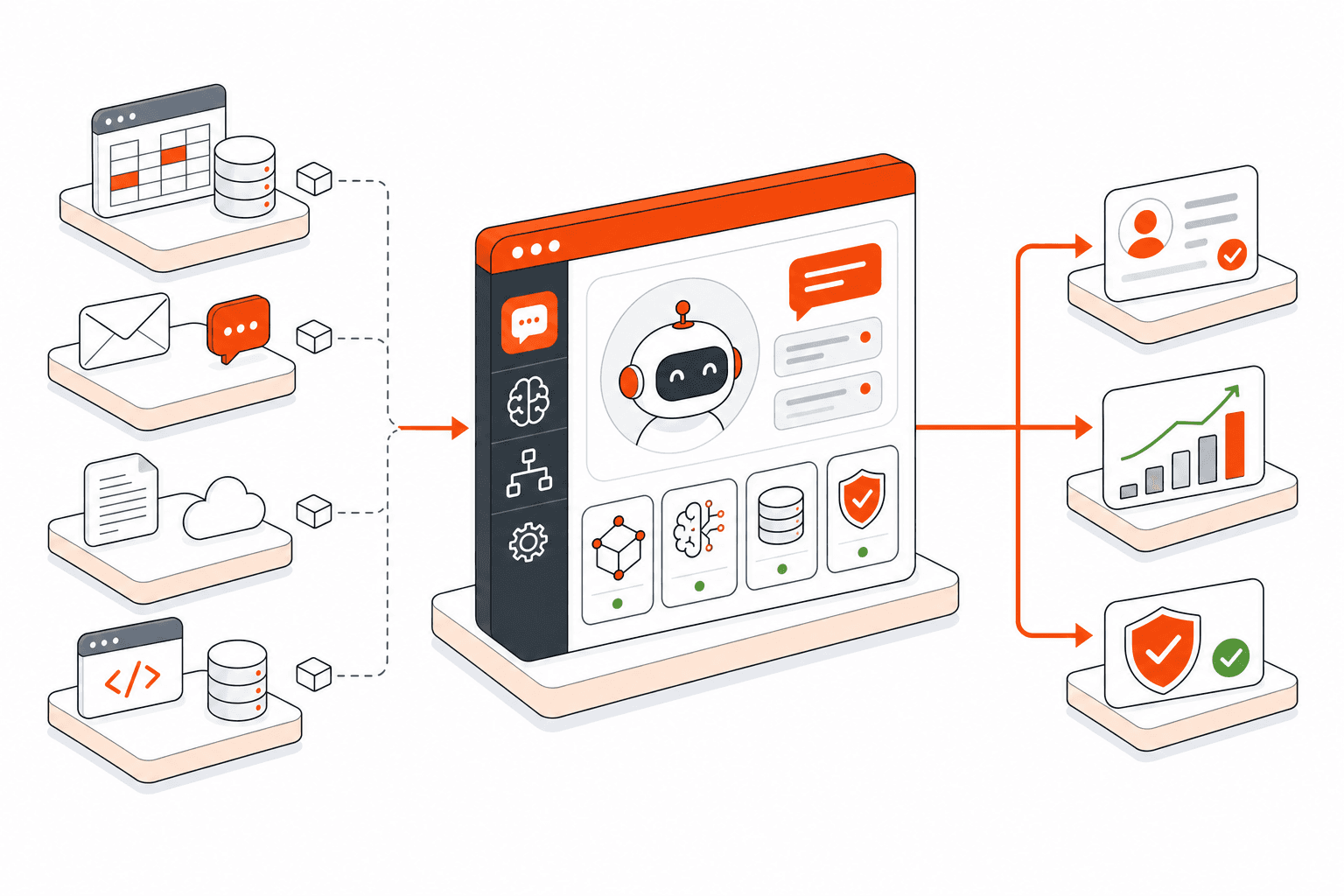
Codalent handles the experience, content, integrations, measurement and operating model—not only the chat widget.
Use-case and conversation design
We define audiences, questions, qualification paths, calls to action, refusal rules and escalation points. Your team gets a focused assistant with clear responsibilities.
Approved knowledge sources
We audit and organise relevant CMS pages, help content, PDFs and product documentation. Visitors receive answers grounded in controlled sources that your team can maintain.
Custom website experience
We implement a responsive, accessible assistant that fits your website, CMS and design system. The experience supports useful conversations without feeling like a disconnected add-on.
CRM and support workflows
The assistant can capture consented details, route qualified enquiries, request meetings or create support tickets through scoped integrations. Teams receive context instead of an isolated transcript.
Human handoff
We define when the assistant should clarify, decline or transfer a conversation. Sales and support retain ownership of sensitive, account-specific and high-value interactions.
Analytics and improvement
We track agreed events such as chat starts, topics, lead capture, bookings, tickets and handoffs. Marketing can identify conversion friction and gaps in website content.
A technical approach matched to the chatbot’s responsibilities
We select the model, retrieval method, interface and integrations after defining the use case, data boundaries, traffic, existing stack and operating requirements.
Retrieval over approved content
Retrieval-augmented generation can search tagged website, CMS, help-centre and document content before answering. Source versions, exclusions and refresh rules help teams manage accuracy as information changes.
Models and orchestration
The solution may use an API-based language model with Node.js or Python orchestration. Selection depends on response quality, latency, cost, data settings, portability and the tools the assistant must call.
Scoped server-side integrations
HubSpot, support desks, calendars or custom APIs can be exposed through validated server-side functions. Least-privilege access, allowlisted actions and confirmation steps reduce operational and security risk.
Evaluation and safeguards
Representative questions, negative cases, retrieval checks and action tests are evaluated before launch and after material changes. Low-confidence or sensitive requests can be refused or transferred rather than answered speculatively.
Website delivery and measurement
We consider widget performance, mobile usability, accessibility, consent, content security policy and rollback. GA4, Google Tag Manager and downstream CRM events can connect conversations to marketing outcomes where feasible.
Move beyond an isolated chatbot experiment
Chatbot projects often stall because content ownership is unclear, CRM permissions arrive late, measurement is missing or different suppliers own the website, data and AI layers.
AI chatbot delivery through an integrated technical team
The subscription provides coordinated access to the capabilities required for implementation, support and continuous improvement.
Subscribe and assemble the team
Your team can include developers, a technical project manager and a marketing-technology expert. You gain flexible technical capacity without building a full internal team.
Prioritise work in ClickUp
Requirements, integrations, content tasks and improvements are organised in a shared ClickUp board. Ongoing prioritisation keeps effort focused and delivery visible.
Collaborate through Slack and weekly calls
A dedicated Slack channel and weekly cadence calls support direct decisions and clear ownership. This is more coordinated than managing separate freelancers and suppliers.
Deliver, review and improve
We release, test and refine the assistant using agreed signals. Codalent AI supports research, planning, documentation and quality assurance, while people retain technical review and accountability.
Not sure which chatbot use case to start with?
Tell us which visitor journey, sales workflow or support process you want to improve. Codalent can help you scope a focused first assistant or the next step for an existing chatbot.
AI chatbot development FAQs
When do we need custom AI chatbot development services?
A self-service tool may suit a basic FAQ widget. Custom development is more appropriate when you need controlled knowledge, a branded interface, CRM or support workflows, attribution, secure actions, human handoff or an ongoing evaluation and improvement process.
Can the assistant use our CMS pages, PDFs and help centre?
Yes, where the sources can be accessed and approved for use. We audit, organise and tag relevant content, define exclusions and plan how updates are refreshed. Retrieval architecture is selected according to content volume, permissions, source formats and answer requirements.
How do you reduce inaccurate or outdated answers?
No AI assistant is error-free. We constrain its purpose, use approved sources, define when it should cite, clarify, decline or escalate, and test representative and adversarial questions. Content ownership, monitoring and regression testing help manage changes after launch.
Can the chatbot connect with HubSpot or our support platform?
Usually, subject to available APIs, licensing, permissions and your data model. We map fields, consent, deduplication, attribution and routing before implementation. Integrations use scoped server-side functions rather than giving the model unrestricted access to business systems.
What is included in the Codalent subscription?
The subscription can include developers, a technical project manager, marketing-technology expertise, a dedicated Slack channel, a shared ClickUp board, weekly cadence calls and Codalent AI-assisted delivery. The exact team and priorities are agreed around your required capabilities.
Can Codalent work with our existing website and chosen technology stack?
Yes, after reviewing the current architecture, CMS, frontend, hosting, analytics and integration constraints. We can work with technology selected by your internal team when it remains suitable, maintainable and compatible with the chatbot’s security and performance requirements.
How are security, data retention and testing handled?
Controls depend on the use case and risk level. We review data minimisation, provider settings, retention, secrets, permissions, logging and human approval requirements. Testing can cover retrieval, refusals, prompt injection scenarios, tool actions, handoffs, accessibility and deployment rollback.
Can we start with one use case and expand later?
Yes. A focused informational, qualification or support-triage use case can establish content governance, measurement and operating practices before adding actions or channels. Expansion is prioritised through ClickUp and reviewed against value, risk, integration effort and available subscription capacity.
Plan an AI chatbot your teams can operate and improve
Tell us which visitor journey, sales workflow or support process you want to improve. We will discuss the content, integrations, safeguards and measurement needed.
Start with the use case and existing stack; a complete technical specification is not required.