Put Gemini to work across your marketing operations
Codalent designs and builds production Gemini integrations for teams using Google Workspace and Google Cloud. Connect approved data, automate structured work and add reliable AI capabilities to your CMS, CRM, internal tools or customer experience.
We start with a focused business task, connect the systems it depends on and build the controls needed to operate it — not an open-ended AI experiment.
Teams supported by Codalent
A complete Gemini workflow — not just a prompt
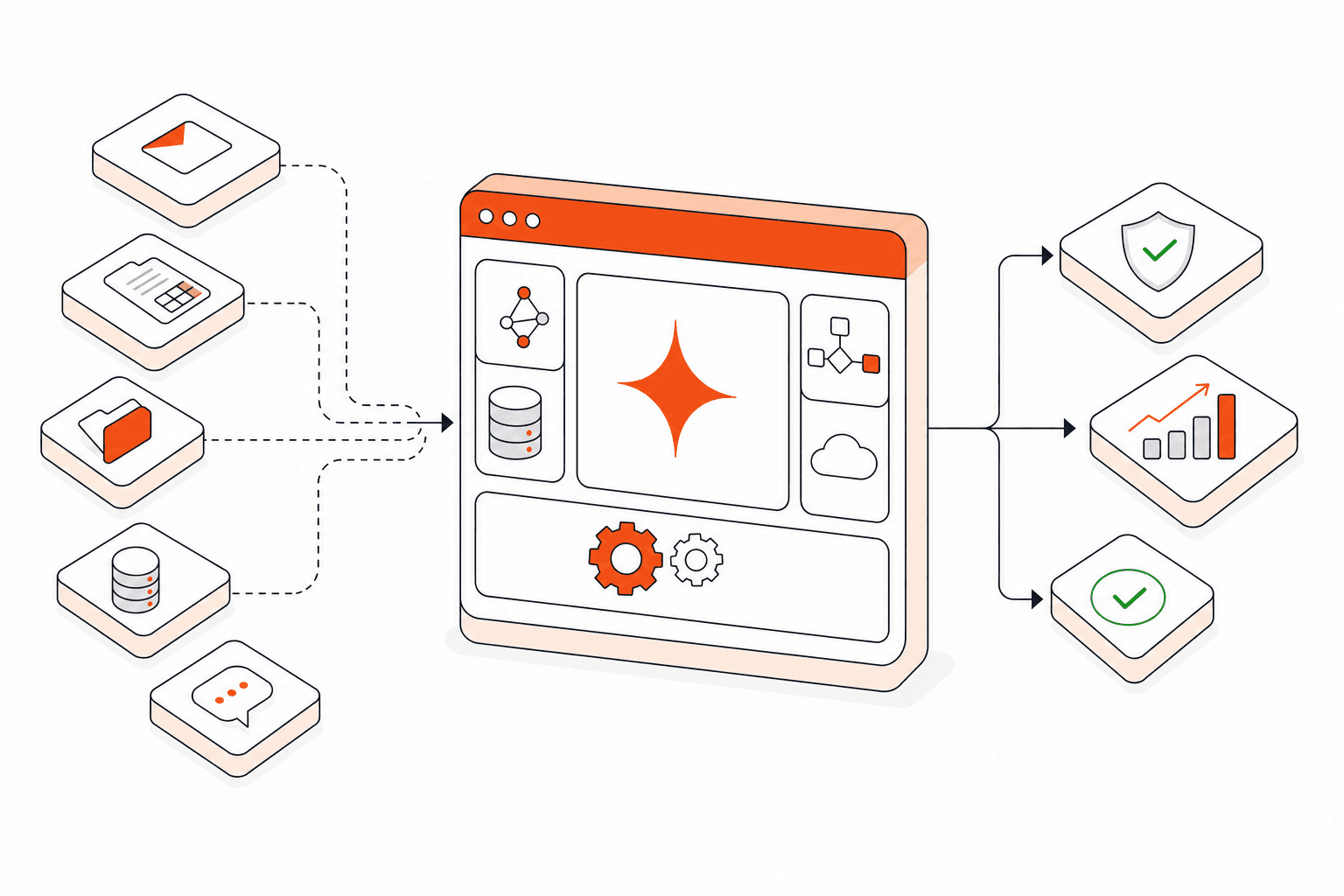
Codalent handles the application, integrations and controls needed to move a useful AI concept into daily operations.
Use-case and workflow design
We map the workflow, users, source systems, approval points, risks and success measures, so your investment starts with a focused business task rather than an open-ended AI experiment.
Custom Gemini applications
Receive a Gemini-powered internal tool, web feature, CMS workflow or automation with the required frontend and backend services, so teams use AI inside a practical working process.
Marketing-system connections
We connect approved systems such as HubSpot, a CMS, GA4, project tools or proprietary APIs so structured outputs move into existing operations without repetitive copying and reformatting.
Knowledge and content workflows
Build approved-document Q&A, campaign-brief extraction, content QA, metadata generation or reporting narratives with sources and review states, so staff reach usable drafts and answers faster.
Testing and operational handover
We create representative test cases, monitoring, documentation, fallback paths and an improvement backlog so your team can operate and refine the integration after launch.
A secure application layer around Gemini
Architecture depends on the workflow, data sensitivity, governance needs and expected usage. Codalent evaluates the access path, identity model, connected systems and operational requirements before selecting the implementation.
Gemini API or Vertex AI
The Gemini Developer API suits many application integrations. Vertex AI may fit teams needing Google Cloud IAM, centralised operations or RAG infrastructure. Selection reflects governance, deployment and maintainability requirements.
Separate Workspace access
Gemini access does not automatically provide access to Drive, Gmail, Calendar or Sheets. Private Workspace data requires its own APIs, OAuth or service-account design, appropriate consent and narrowly scoped permissions.
Structured and controlled actions
JSON Schema outputs support extraction, classification and routing. Function calling can propose system actions, but server-side authentication, argument validation, business rules and approval gates control production writes.
Grounding and quality evaluation
Knowledge workflows can retrieve approved sources and display citations. We also test factual support, extraction quality, prompt-injection cases and tool behaviour because retrieval alone does not ensure correctness.
Deployment and cost controls
Credentials remain server-side with appropriate secret management and IAM. Logging, retries, queues, usage measurement and budget thresholds improve reliability and make token, grounding and traffic costs easier to manage.
Move beyond disconnected Gemini experiments
Common blockers include prototypes without production ownership, manual handoffs between Workspace and marketing systems, broad or unclear data access, unreliable free-form outputs and no plan for testing, monitoring or ongoing changes.
An integrated team for delivery and continuous improvement
Your subscription can combine developers, a technical project manager and marketing-technology expertise. It provides more coordination than separate freelancers, more flexibility than building a full internal team and clear ownership beyond a one-off handover.
Subscribe and assemble the team
We match the required development, technical project management and marketing-technology capabilities to the current priorities. You gain flexible access without recruiting every role internally.
Prioritise work in ClickUp
Requirements, technical tasks, risks and decisions are organised in a shared ClickUp board. Ongoing prioritisation keeps delivery aligned with the highest-value workflow.
Collaborate every week
Use a dedicated Slack channel and weekly cadence calls for questions, reviews and decisions. Codalent AI supports research, planning, documentation and quality assurance under human technical oversight.
Deliver, review and improve
We release tested increments, review usage and quality, and adjust the backlog as requirements change. You retain transparent visibility while the integration receives ongoing support and improvement.
Planning a new Gemini build, integration or improvement?
Tell us which process, Workspace data and business systems are involved. We will discuss the workflow, integration boundaries, controls and technical ownership required — starting from an existing prototype or a clearly defined operational problem.
Google Gemini integration FAQs
We already use Gemini in Google Workspace. Why do we need an integration?
Workspace product features do not automatically create a custom workflow across your CMS, CRM, analytics, approvals and proprietary systems. An integration adds the application logic, authorisation, validation, user experience and operational controls needed for a repeatable business process.
Can Gemini securely use Drive, Gmail, Sheets or Calendar data?
Yes, when the use case and applicable Google policies permit it, but Workspace access is designed separately from Gemini model access. Codalent assesses OAuth, service accounts, possible administrator requirements, scopes and token storage, then requests the narrowest practical permissions.
Should we use the Gemini API or Vertex AI?
The decision depends on your workload and operating environment. The Gemini Developer API can suit many custom applications, while Vertex AI may be preferable for Google Cloud IAM, centralised cloud operations or retrieval infrastructure. We document the trade-offs before implementation.
Can Gemini update our CMS, HubSpot or another business system?
It can propose or perform constrained actions through approved APIs. We use structured responses, server-side authentication, validation and business rules before writes occur. Human approval can be included for publishing, customer communication or other actions where errors carry greater risk.
How do you test quality, security and reliability?
We test representative inputs, expected outputs, source support, tool calls, failure states and prompt-injection scenarios. Deployment planning can also cover secret management, permissions, logging, retries, rate limits and cost monitoring. Testing reduces risk but does not guarantee error-free model output.
What is included in the Codalent subscription?
The subscription can include developers, a technical project manager, marketing-technology expertise, a dedicated Slack channel, a shared ClickUp board and weekly cadence calls. The exact team and priorities are shaped around the integration, connected systems and ongoing support needs.
Can Codalent improve an existing Gemini implementation?
Yes. We can review an existing prototype or production workflow, including architecture, prompts, authentication, data access, structured outputs, testing, monitoring and deployment. Work is then prioritised in the shared backlog, whether the need is stabilisation, extension or ongoing maintenance.
Who owns the completed work, and what happens when requirements change?
Ownership and commercial terms are confirmed in the engagement agreement. Requirements can be reprioritised through the shared ClickUp backlog and weekly cadence. This allows the team to respond to operational feedback, platform changes and new use cases without losing visibility or technical ownership.
Plan a Gemini workflow your team can operate
Tell us which process, Workspace data and business systems are involved. We will use the conversation to clarify the use case, integration boundaries and appropriate next steps.
Share what you know today; a complete technical specification is not required for the first conversation.