Fix accessibility barriers in your existing marketing website
Codalent helps marketing and web teams identify, prioritise and remediate accessibility issues in source code, CMS modules and shared components — without treating the work as a full redesign.
We can start from an existing audit, a specific user journey or a scoped technical review — no prepared specification required.
Trusted delivery support for marketing teams
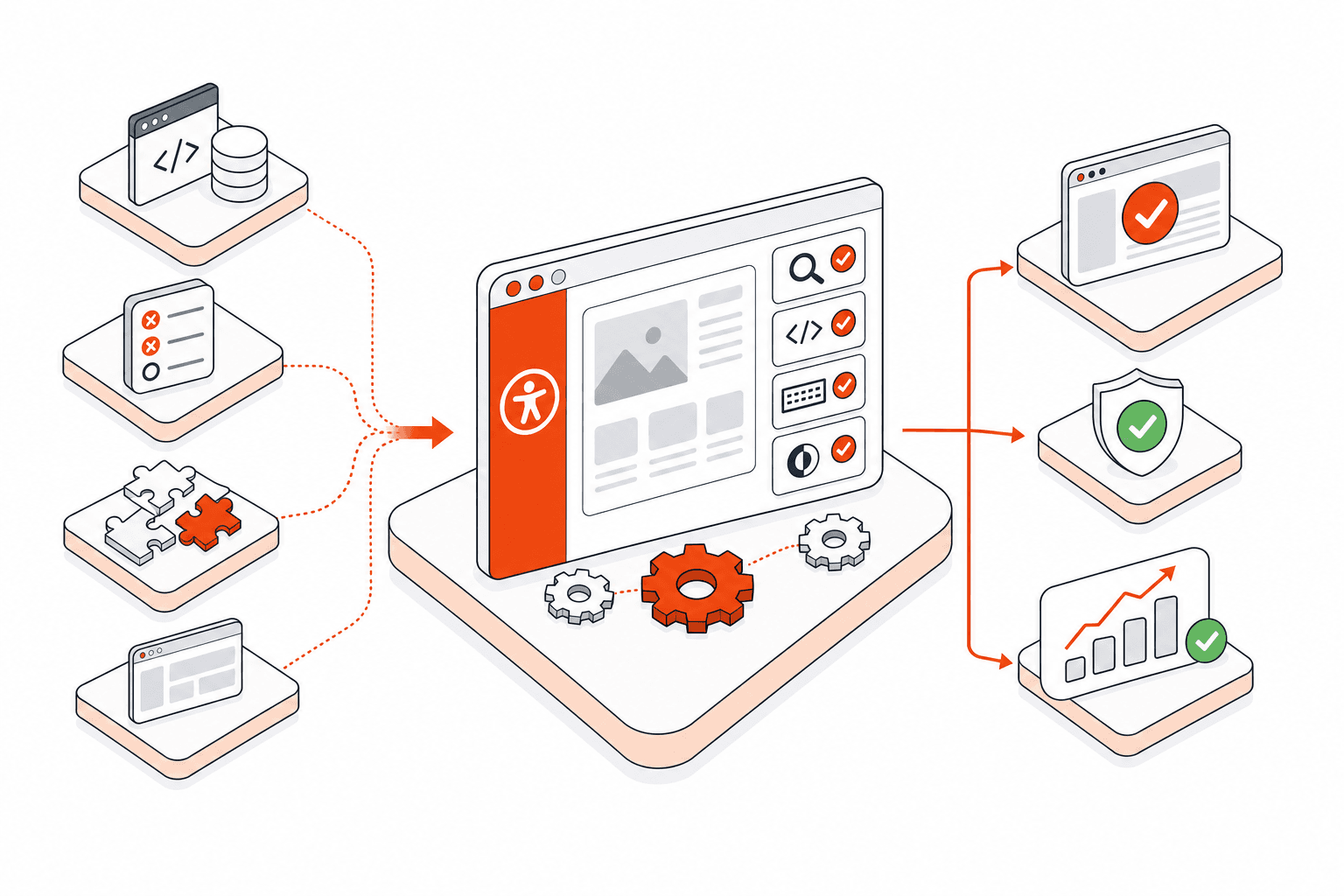
From accessibility findings to tested website improvements
We turn audit results and real user barriers into an implementation-ready backlog and controlled releases.
Defined scope and priorities
We map domains, templates, components, key journeys, integrations and exclusions before work begins. Your team gets a focused plan instead of an open-ended list of URLs.
Source-code remediation
We fix reusable components, templates and CMS modules through your repository and delivery workflow. Improvements can propagate across high-traffic pages rather than being patched one page at a time.
Conversion-path protection
Navigation, forms, gated content, booking and registration flows are prioritised alongside visual and analytics regression checks. Marketing activity can continue while changes are released in controlled increments.
Validation and closeout evidence
We retest representative flows with automated checks and manual evaluation, then document resolved items, residual risks and vendor-owned limitations. Stakeholders receive a clear record of what changed.
Regression prevention
We add practical component guidance, authoring guardrails and release checks for future campaigns. Your team has a more repeatable way to publish accessible content.
Technical remediation built for real website stacks
The right approach depends on your target standard, CMS, component reuse, source access and third-party dependencies. We scope these constraints early, then make maintainable fixes at the layer where they will have the most impact.
WCAG target and test scope
WCAG 2.2 AA is often a useful engineering target for commercial sites. Requirements vary by organisation and jurisdiction, so we agree the technical target, representative pages and validation method before implementation.
Semantic components first
We prefer native HTML for controls, headings, landmarks and forms, using ARIA only when custom behaviour requires it. This reduces fragile code and improves support across browsers and assistive technologies.
Dynamic interaction testing
We test keyboard operation, visible focus, dialogs, menus, accordions, validation messages and responsive reflow — not just static scan results. This protects the interactive journeys that drive enquiries and registrations.
CMS and platform-aware fixes
WordPress, HubSpot, headless CMS, React, Next.js and custom sites need different remediation paths. We assess templates, plugins, themes and content controls to avoid fixes that are overwritten or hard to maintain.
Automated and manual validation
Automated checks are useful for scale and regression detection, but they cannot assess every accessibility barrier. We pair them with manual testing of agreed journeys and document known exclusions, including vendor-controlled embeds.
Replace fragmented remediation with clear technical ownership
Accessibility work often stalls between audit providers, internal developers, CMS owners and marketing teams. Codalent provides one coordinated delivery path.
An accessibility team that works inside your marketing operation
Your subscription provides flexible access to the technical capability required for remediation, release support and continuous improvement.
Subscribe and assemble the team
We align developers, a technical project manager and marketing-technology support around your website, access model and priorities. You gain coordinated capacity without building a full internal team.
Prioritise work in ClickUp
Issues, acceptance criteria, dependencies and release priorities are managed in a shared ClickUp board. Your team can see what is blocked, in progress, ready to test or complete.
Collaborate in Slack and weekly calls
A dedicated Slack channel and weekly cadence calls keep decisions moving across marketing, design and technical stakeholders. Questions are handled in context, not lost in handovers.
Deliver, review and improve
We ship reviewed changes, validate agreed journeys and refine the backlog as releases evolve. Codalent AI can accelerate research, documentation and QA support, while people retain technical ownership and decision-making.
Have an audit or scanner results you need to act on?
Bring an existing audit, a specific user journey or known website issues. We will help translate them into a prioritised, testable remediation plan.
Website accessibility remediation FAQs
What is website accessibility remediation, and how is it different from an audit?
An audit identifies potential barriers and evaluates a defined scope. Remediation is the hands-on work of translating those findings into prioritised source-code, CMS, design and content changes, then retesting the affected journeys. Codalent can work from an existing credible audit or help establish a baseline.
Can you remediate our existing site without a full redesign?
Usually, yes. Many issues can be addressed through semantic markup, interaction behaviour, focus treatment, component variants, form feedback and content controls. When a design decision needs to change, we flag the impact clearly and test key conversion paths rather than treating redesign as the default.
Which standard will you remediate against?
We agree a technical target during discovery based on your contracts, risk posture and applicable requirements. WCAG 2.2 AA is often appropriate for commercial engineering work. For covered U.S. state and local government content, the DOJ Title II technical standard is WCAG 2.1 AA; legal interpretation should come from your counsel.
Why do we need manual testing if we already use an automated scanner?
Scanners are useful for repeatable detection and regression monitoring, but they cannot determine overall conformance. Keyboard paths, focus management, screen-reader behaviour, meaningful alternatives and error recovery need human evaluation. We combine both methods for the agreed pages and user flows.
Can you work with our CMS, theme or existing technology stack?
Yes, subject to discovery and access. We assess your repository, CMS templates, component library, deployment process, plugins and third-party embeds before committing to scope. We can work with internal technology choices and identify which issues are controllable in code versus vendor-owned or content-led.
What is included in the subscription and how is work prioritised?
The subscription can include developers, a technical project manager, marketing-technology expertise, a dedicated Slack channel, shared ClickUp board and weekly cadence calls. We prioritise critical blockers, shared-component defects, high-traffic journeys, release constraints and dependencies with your team.
Can you support ongoing accessibility work after the initial remediation?
Yes. Ongoing support can cover new campaign pages, component improvements, periodic regression testing, content-authoring guidance and accessibility-aware feature work. This is useful when frequent publishing, experiments or vendor changes could reintroduce barriers.
Will Codalent certify that our website is ADA compliant?
No. We do not provide legal certification or make blanket compliance promises. We provide scoped remediation and documented validation against an agreed technical target, including exclusions and residual risks. Your legal counsel can advise on legal obligations and risk interpretation.
Build a practical path from accessibility findings to verified fixes
Bring your audit, scanner results or known website issues. We will help define a remediation scope that fits your site, marketing priorities and release workflow.
We can start with an existing audit, a specific user journey or a scoped technical review — no legal certification implied.