Put OpenAI to work inside your existing systems
Codalent helps product, marketing and operations teams build secure OpenAI API integrations for content workflows, knowledge access, classification, routing and controlled actions across websites, CMSs, HubSpot, CRMs and internal tools.
We select the simplest architecture that meets your quality, security and operational requirements — not a predetermined chatbot.
Trusted by teams that need dependable technical delivery
From defined workflow to maintainable OpenAI integration
We focus the project on a real task, connect it to the right systems and give your team a measured path to launch and improve it.
Workflow discovery
We map users, data sources, approval points, risks and success measures. You get a focused scope instead of a broad AI assistant brief.
System integration
We connect the workflow to approved CMS, CRM, HubSpot, analytics or proprietary APIs. Your team works inside familiar systems rather than another isolated tool.
Product and internal interfaces
We build website, product or internal-tool interfaces with clear loading, source, fallback and escalation states. Users receive a practical experience, not a technical demo.
Knowledge and action controls
We define which information the integration can retrieve and which actions it may request. Permissions and human approvals protect sensitive workflows.
Evaluation and monitoring
Representative test cases, quality checks and usage reporting make output quality, failures and API spend visible before and after launch.
Documentation and improvement
You receive documented architecture, source-controlled implementation and an optimisation backlog. The integration remains easier to operate as requirements change.
A technical approach designed around the workflow
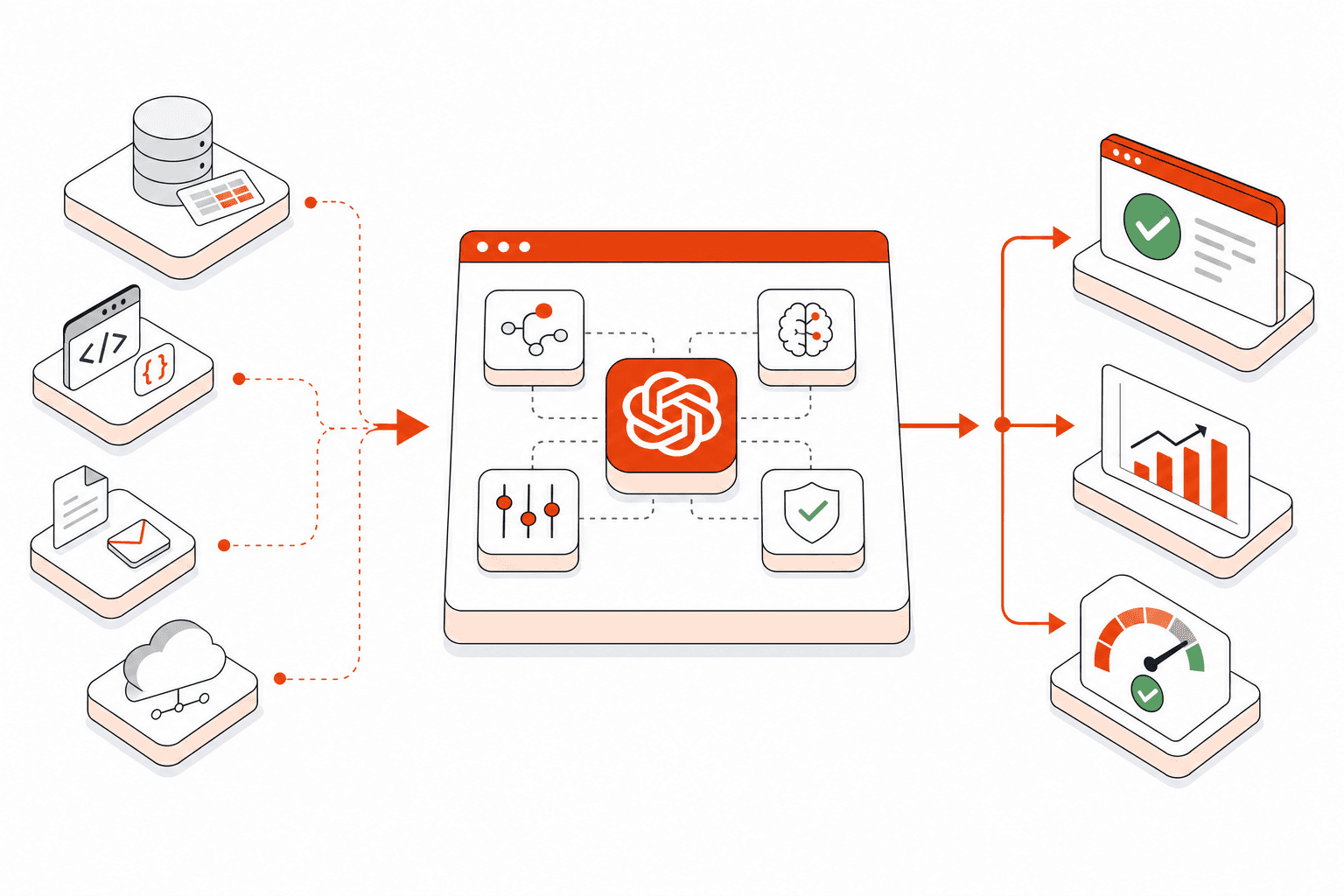
Architecture depends on the task, available APIs, data sensitivity, expected traffic and required response time. Codalent selects the simplest approach that can meet the quality, security and operational requirements.
Server-side API orchestration
OpenAI API requests run through a backend such as Node.js or Python, with secrets kept out of browser and mobile code. This supports secure credentials, authentication, rate limits and reliable integration logic.
Retrieval or structured output
Knowledge workflows may retrieve permission-appropriate sources and present citations. Extraction and routing workflows can use constrained schemas so outputs are validated before entering a CMS, CRM or other system.
Controlled tool calls
Approved functions can look up records, create drafts or open tickets. Allowlisted actions, scoped credentials, payload validation and approval gates reduce the risk of unintended changes.
Evaluation and resilience
Representative evaluations are rerun when prompts, models, sources or tools change. Logging, request tracing, retries, idempotency and fallback paths improve maintainability and troubleshooting.
Cost and data controls
We plan token budgets, limits, caching or background processing where useful. Data retention and regional requirements are reviewed by endpoint and configuration; API usage is billed separately from ChatGPT subscriptions.
Move beyond disconnected prototypes and unclear ownership
OpenAI projects often stall when the workflow is too broad, production systems have no clear owner, output quality is judged through demos, or security and cost controls arrive late.
OpenAI delivery through an integrated Codalent subscription
Access the technical capabilities you need without coordinating multiple freelancers or building a full internal team. Codalent works as an accountable extension of your team for delivery, support and improvement.
Subscribe and assemble the team
Your subscription can include developers, a technical project manager and a marketing-technology expert. You gain flexible access to the capabilities required by the workflow.
Prioritise work in ClickUp
Requirements, risks and tasks are managed in a shared ClickUp board with ongoing prioritisation. Everyone can see what is planned, active and awaiting review.
Collaborate through Slack and weekly calls
A dedicated Slack channel and weekly cadence calls keep decisions and blockers visible. Codalent AI can support research, planning and documentation while people retain technical ownership.
Deliver, review and continuously improve
We release work, evaluate results and plan the next priority. Transparent delivery supports ongoing optimisation as usage, knowledge sources and business requirements change.
Not sure which AI workflow to build first?
Tell us which task, system and users are involved. Codalent can help you identify a suitable first workflow or the next step for an existing OpenAI integration.
OpenAI integration questions
What is the difference between ChatGPT and an OpenAI API integration?
ChatGPT is a standalone product. An API integration lets your software send approved information to OpenAI and use the response inside a defined website, product or operational workflow. API access and usage are managed and billed separately from ChatGPT subscriptions.
Can you connect OpenAI to our website, CMS, HubSpot or internal APIs?
Yes, where suitable APIs and permissions are available. We review the systems, data flows, authentication and intended actions before confirming the architecture. Connections can support retrieval, structured data entry, draft creation, classification, routing and other bounded workflows.
How do you reduce inaccurate answers or unsafe actions?
We narrow the task, use approved knowledge where relevant, constrain output formats and validate tool inputs. Representative evaluations, source presentation, permission checks and human approval can be added according to risk. These controls reduce risk but do not make probabilistic output error-free.
Will our API data be used to train OpenAI models?
OpenAI states that API inputs and outputs are not used for model training by default unless the customer opts in. Retention, application state and enhanced data-control eligibility vary by endpoint and configuration, so we review the proposed workflow with your security and legal stakeholders.
How are OpenAI API costs controlled?
We estimate usage around the specific workflow and expected volume, then consider model selection, token limits, caching, batching and background processing where appropriate. Monitoring can report usage and flag unusual activity. OpenAI bills API consumption separately, and costs may change over time.
What is included in the Codalent subscription?
The subscription can include developers, a technical project manager, marketing-technology expertise, a dedicated Slack channel, a shared ClickUp board and weekly cadence calls. The exact team and priorities depend on the integration, existing stack and ongoing support requirements.
Can Codalent maintain or improve an existing OpenAI integration?
Yes. We can review the architecture, prompts, data sources, permissions, evaluation coverage, monitoring and deployment process. Work is prioritised in the shared backlog, whether the immediate need is stabilisation, a new system connection, cost control or ongoing optimisation.
Who owns the completed work?
Ownership, account access and handover requirements are agreed before delivery. We can work with a client-controlled OpenAI account and provide source-controlled code, architecture documentation and operational guidance so the implementation is not dependent on undocumented agency knowledge.
Turn one valuable AI workflow into a production-ready integration
Tell us which task, system and users are involved. We will help you identify the right scope, technical approach and next step without assuming that every use case needs a chatbot.
Start with the workflow and existing stack; a complete technical specification is not required.